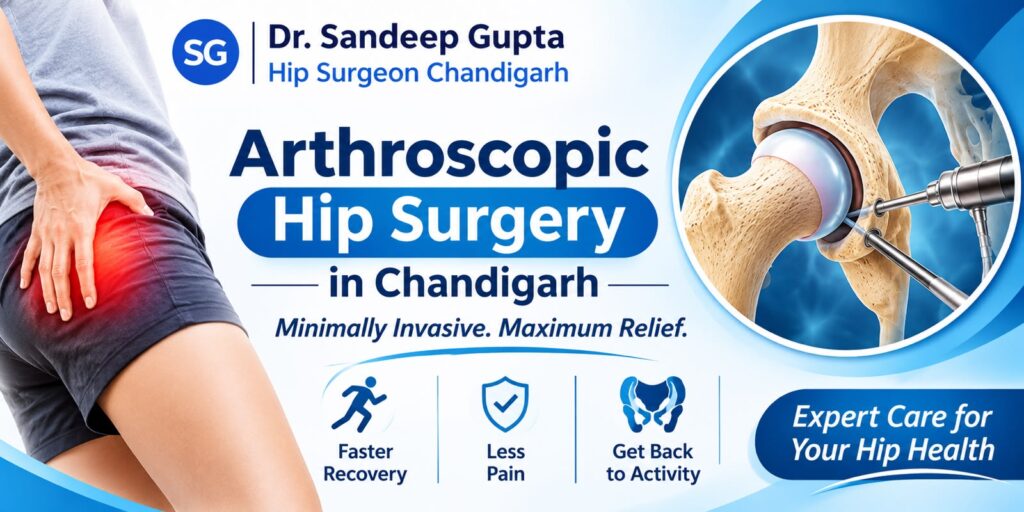
Hip pain can impact your everyday activities, from simple tasks like walking to strenuous activities like exercise. Sometimes medication and physical therapy can help with hip pain. More severe cases may require additional treatment. Arthroscopic hip surgery is one option to diagnose and treat selected conditions.
If you’re interested in learning more about arthroscopic hip surgery Chandigarh, this article will help you make an informed decision by outlining the procedure, benefits and how long it takes to recover. This type of surgery can be used to treat labral tears, femoroacetabular impingement and loose joint fragments.
If you are interested in this type of surgery, you should see an orthopaedic specialist in Chandigarh to determine if it’s the best treatment option for you.
Hip arthroscopy is performed on select conditions that affect the hip joint.
-
Hip Labral Tears
The labrum is a cartilage ring that helps provide stability and support to the hip socket joint.
Labral tears can happen from an injury, repetitive movements, or abnormal hip socket shape.
Some of the symptoms of a labral tear can be pain in the groin or hip, stiffness while moving the hip, clicking or catching while moving the hip, discomfort while sitting for a long time, and pain while playing or doing any activity that involves moving the hip.
Based on the extent of damage, the surgeon can recommend appropriate treatment.
-
Femoroacetabular Impingement (FAI)
FAI is also called cam impingement. It is a condition where the femur and the acetabulum (hip socket) are not of regular shape and both bones rub against each other during movement and cause irritation. This can also lead to damage to the articular cartilage and labrum.
If this is the case, a surgeon can perform a hip arthroscopy to improve the irregularity on the bone and other soft tissue injuries.
-
Loose Bodies
Some small pieces of cartilage or bone can come lose and be present in the joint. These can cause pain, click and catch.
A hip arthroscopy can help in removal of the loose bodies.
-
Synovial Conditions
The lining of the joint is called synovium. There can be inflammation of the synovium which can cause pain and swelling of the joint.
In certain cases, a hip arthroscopy can help in looking into the joint and treating the inflammation.
Arthroscopic hip surgery has a number of potential advantages to the right patient.
First, the incisions made in the hip are considerably smaller compared to traditional hip surgery.
Also, visual access to structures within a joint can be assessed with an arthroscope.
Further, some conditions of the hip such as a labral tear or a loose body can be addressed with an arthroscope during the same surgery.
Pain relief from the surgery can allow for early function of the hip.
Further, soft tissues surrounding the hip may not be disrupted as much compared to traditional surgery of the hip.
The above benefits are relative to the condition treated and individual case. Hip arthroscopy chandigarh does not always guarantee pain relief.
Who is a Candidate for Hip Arthroscopy?
Not every patient with hip pain is a candidate for arthroscopic surgery.
The following factors are usually considered by an expert:
-The nature and extent of the hip condition
-The patient’s age and level of activity
-The status of the hip joint cartilage
-The condition of the hip bones
-The patient’s response to prior, conservative (nonsurgical) treatment
-The results of radiographs and MRI
Patients with more advanced hip arthritis or patients with significant loss of hip cartilage are often not candidates for hip arthroscopy. In these patients, other measures may be considered.
What Happens Prior to Hip Arthroscopy?
Prior to any surgical procedure, it is important to understand the anatomy being operated on and the potential problems that may exist. This, in turn, allows for the proper planning for surgery and the attainment of the optimal result.
How Long Does the Whole Process Take?
The surgeon will require some time to gain an understanding of your condition. There will be a discussion regarding any symptoms you may have, and a review of your past medical history. Any previous injuries may also be considered. Once the surgeon has identified activity limitations, the surgeon will have a better idea of the steps needed to develop a full assessment and subsequent plan for treatment.
What Does The Assessment Involve?
After the required information has been gathered, a physical assessment of the hip and surrounding leg will be performed. There are a number of investigative methods available to the surgeon. X-rays and MRIs are just a couple of the options. Once the required information has been gathered, treatment planning can begin.
What does Treatment Planning Involve?
The surgeon will have discussed a number of options with the patient. The advantages and disadvantages of each option are considered. Hip arthroscopy may be recommended once these steps are complete.
Physiotherapy
Rehabilitation generally involves gentle movements and exercises to strengthen muscles and improve flexibility. This process is progressive and continues until the patient is able to perform all of their routine activities, including sports.
Returning to Daily Activities
Patients return to performing their daily activities as their strength and mobility improve. The time frame for this improvement varies with the individual.
Returning to Sports
Depending on the nature of the condition, sports persons may require a planned rehabilitation program in order to return to sporting activities.
It is essential to follow the instructions of the surgeon in order to protect the repaired structures of the hip joint and to help the healing process.
What Are the Possible Risks of Hip Arthroscopy?
There are risks associated with any type of surgical procedure, and hip arthroscopy is no exception. These may include:
- Infection at the surgical site.
- Bleeding.
- Blood clots.
- Temporary numbness and nerve irritation.
- Stiffness of the joint.
- Persistent pain.
- Incomplete improvement of symptoms.
The surgeon will be able to inform you about the specific risks related to your case.
Frequently Asked Questions
-
What is the goal of arthroscopic hip surgery Chandigarh?
Its aim is to assess and manage select hip joint problems such as labral tears, femoroacetabular impingement and loose bodies.
-
What is the difference between hip replacement and hip arthroscopy?
Hip replacement is used to treat advanced hip joint problems, while hip arthroscopy is performed to manage select hip joint problems.
3. Is hip arthroscopy a big surgery?
It is a minimally invasive surgery, however, it still requires planning and post-operative rehabilitation.
4.Is hip arthroscopy suitable for arthritis?
Hip arthroscopy cannot be performed for advanced hip arthritis as advanced cartilage damage restricts the benefits of the procedure.
-
Can I walk after hip arthroscopy?
Walking is commonly done in the first few days after surgery, however, weight bearing is restricted based on the surgery performed.
-
Is physiotherapy necessary after hip arthroscopy?
Yes. This is essential to improve range of motion and muscle strength and help in resuming daily activities.
-
How do I know if I need hip arthroscopy?
A clinical examination with appropriate imaging can help make the diagnosis and offer a treatment plan.
If you have hip pain that is affecting your routine activities and exercise, you should not ignore it. Hip pain that prevents you from walking is not normal and should be evaluated by a specialist.
If you are planning arthroscopic hip surgery chandigarh or hip arthroscopy, consultation with a specialist is essential for evaluation of your case and offer treatment options.
NAP — Name, Address and Phone
Name: Dr. Sandeep Gupta — Hip & Knee / Orthopaedic & Joint Replacement Surgeon
Primary location: Max Super Speciality Hospital, Phase 6, Sector 65, Mohali, Punjab 160065
Panchkula consultation: House No. 222, Sector 4, Panchkula, Haryana 134112
Phone: +91 98159 33514
Email: contact@cojri.com
Website: https://hipsurgeonchandigarh.com/