



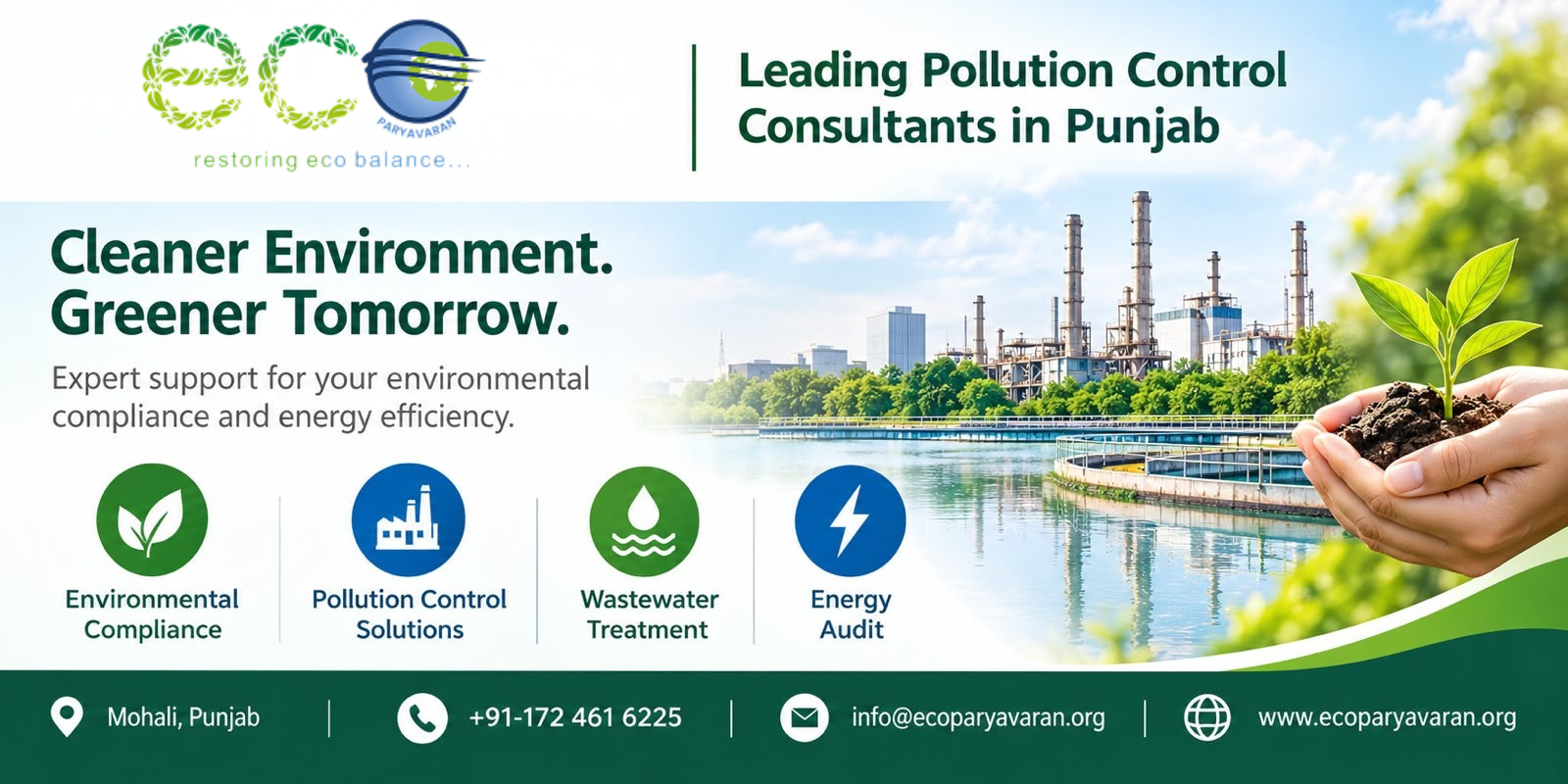
Complete Energy and Environment Guide Environmental compliance and energy efficiency are becoming more important to industries in Punjab. This includes manufacturing, commercial and industrial facilities as well as large infrastructure projects. They need to effectively manage their pollution risk while keeping their operational costs under control.
There are many factors that can negatively impact the environment and impact a company’s long term business interests. These include air emissions, wastewater, solid and hazardous waste, and high energy consumption. Addressing the above challenges requires an interdisciplinary team consisting of engineers, scientists, environmental experts, and lawyers.
This is where a competent pollution control consultant for businesses in Punjab becomes valuable. Most consultants can provide environmental due diligence and analysis to assist their clients to understand their legal requirements, identify pollution sources, perform environmental monitoring and/or provide and implement treatment systems to address pollution.
Finding ways to reduce the energy consumed by various facilities is also crucial. This can be done by determining where and how losses occur in various equipment and/or improve equipment performance.
This guide outlines key services offered by environmental consultants in Punjab, as well as energy audit services for industries
Why Do Industries Need Pollution Control Consultants in Punjab?
Punjab hosts a wide range of industries, including manufacturing, food processing, textiles, engineering, chemicals, pharmaceuticals, and others. Each industry has its own environmental concerns and compliance needs. Within an industry, individual units may face different kinds of air emissions, wastewater and waste management concerns. Each unit may also have to maintain and operate different kinds of pollution control equipment.
Benefits of a pollution control consultancy
There are various advantages of engaging pollution control consultants, and these are highlighted below.
Regulatory Compliance
Understand the type of approvals, consents and authorizations applicable to your operation and in the process reduce the risk of arbitrary enforcement action by the regulator.
Pollution Prevention
Identify the potential air emission sources, and the generation of wastewater, solid waste and noise. Take effective and efficient preventive measures to reduce pollution potential of your activities.
Treatment
Assess the existing treatment systems and suggest measures for improvement.
Sampling and Analysis
Carry out sampling and analysis and request related services from qualified laboratories, and other service providers.
Operational Efficiency
Monitor and improve documentation and maintenance practices for facilitation of regulatory inspections.
Efficiency in use of natural resources
Improve the efficiency in use of natural resources (i.e. energy, water and raw materials) and reduce wastage.
Businesses should consider the benefits of pollution control beyond getting approvals and what effect improvement of processes will have on the business.
What should you look for in top pollution control consultants in Punjab?
While comparing quotations is an important exercise, businesses should assess technical capabilities and service scope of consultants and their ability to support in preparation of regulatory documents and its practical implementation.
- Eco Paryavaran
Based out of Mohali, Eco Paryavaran Group is a consortium of engineers and environmental consultants offering services on environmental advisory, statutory clearance, laboratory testing, environmental monitoring, environmental treatment and pollution control, and water and waste water treatment.
They have the capability to execute (engineer) EIAs, EMPs, consent management, environmental audits, sustainability assessments and other related engineering services.
The group has received QCI-NABET accreditation for EIA consultancy across 12 sectors. Businesses should check the current approved scope and applicable qualifications for the assignment in question.
Comparison of Environmental Consultancy Service Providers
When assessing service providers, consider the following:
- Relevant experience in your industry and with the types of facilities you operate.
- Relevant accreditations, recognition and approved scope of work for regulated activities.
- Availability of environmental test facilities.
- Pollution control engineering and treatment technologies.
- Regulatory application experience and processes in the province of Punjab.
- Professional fees, deliverables, and project timelines.
- Availability of maintenance and monitoring services.
- Familiarity with ongoing and continuing legislative requirements.
- The consultant you select should match the project requirement rather than being selected based on an unverified ranking.
Significant Pollution Control Laws of Punjab
The requirements of environmental law depend on the nature of the industry, location, pollution potential and the legal requirements and approvals, if any.
The following requirements deserve special focus:
Consents to Establish and Consent to Operate
The Punjab Pollution Control Board (PPCB) administers the process of granting CTE and CTO in accordance with the provisions of the Water (Prevention and Control of Pollution) Act, 1974 and Air (Prevention and Control of Pollution) Act, 1981, respectively.
Consultants can help assess applicability, prepare applications and supporting documents, and help comply with conditions of consents.
Businesses should confirm the latest procedures and applicable exemptions or category-specific requirements through the official website of the Punjab Pollution Control Board (PPCB) and relevant single window access services of the Punjab government.
Environmental Clearance
Projects in the specified sector require Environmental Clearance in accordance with the respective EIA (Environmental Impact Assessment) framework.
- Depending on the project, the following may be required:
- Determining whether the project is in a regulated category.
- Baseline environmental assessment.
- Impact assessment (Air, Water, Noise, Ecology).
Preparation of Environmental Impact Assessment Report and Environmental Management Plan, where required.
Addressing queries of the regulating authorities and completion of consultation process.
Not all industries require Environmental Clearance. This has to be determined in light of the Rules, nature of project, and recent amendments.
Control of Air Pollution
In the case of industrial processes and activities that lead to the emission of dust, fumes, gases and other pollutants, appropriate control measures are to be adopted as per the source, process and the applicable emission standards.
Possible control options may include:
- Bag/cartridge/electrostatic filters.
- Scrubbers (wet or dry).
- Cyclone separators.
- Improved process ventilation.
- Stack Monitoring and preventive maintenance.
- Modifying the process to reduce emissions.
Determining the appropriate control options requires a technical assessment based on the nature of the pollutants, operating conditions, etc.
Treatment of Industrial Wastewater
Various industries generate different types of wastewater (containing suspended and dissolved solids, oils, greases, chemicals and other pollutants) as by-products of their processes.
Treatment of industrial wastewater may include:
- Use of treatment plant for removal of suspended solids (Effluent Treatment Plant).
- Biological and/or Physicochemical treatment.
- Use of sewage treatment plant for treatment of domestic sewage (Sewage Treatment Plant).
- The assessments will address the use of membrane and filtration-based processes.
- The assessments will review treated wastewater recycling and reuse.
- Zero Liquid Discharge (ZLD) will be addressed where technically and legally appropriate.
Consultants will assess wastewater quality, define required treatment, and suggest appropriate treatment systems based on discharge and/or reuse requirements and operating costs.
Hazardous Waste and Industrial Waste Management
Various facilities generate hazardous wastes, used oils, chemical residues, contaminated materials and/or other regulated waste streams.
Depending on the applicable waste regulations, industries may require authorizations, safe storage, records and/or manifests, as well as arrangements with an authorized transporter or disposal facility.
A waste management assessment may help identify wastes, improve waste stream segregation and separation, and eliminate the generation of wastes that should not be generated. This can help establish processes for the safe and proper management of wastes.
What Does an Industrial Energy Audit Include?
- Energy Consumption Evaluation
The auditor will review energy and fuel usage records, production data, schedules, and operating records.
This helps establish a baseline and identify unusual consumption patterns.
- Evaluation of Electrical Systems
Industrial electrical systems may be assessed for inefficient motors, transformer losses, power factor, load distribution, and control.
Recommendations should be based on actual measurements and operating requirements of the facility.
- Boiler and Thermal Systems
For facilities using steam or process heat, the audit may assess performance of boilers, insulation, steam leaks and losses, condensate, combustion and process losses.
Improving insulation and recovering or utilizing waste heat may significantly reduce fuel consumption.
- Compressed Air Systems
Convenience of compressed air may mask a significant expense to produce. Audits may identify air leaks, pressure set too high, inefficient compressors and opportunities to improve controls. - HVAC and Lighting
Upgrading or modifying lighting and HVAC may provide opportunity to reduce energy use in suitable facilities. - Renewable Energy
Based on site conditions, loads, and priorities, the assessment may include solar PV or other options. - Cost Benefit Analysis
The report should recommend options in order of potential energy savings, cost to implement, operational feasibility, and estimated payback.
Realized savings will depend on the existing conditions of the facility, equipment and systems, use and occupancy, the location and price of energy, and the quality of the improvement.
Benefits of Industrial Energy Audits
The benefits of an industrial energy audit may include:
- Opportunity to reduce electricity and fuel consumption.
- Identification of inefficient equipment and operating practices.
- Improved equipment reliability and reduced maintenance costs.
- Reduced energy costs per unit of production.
- Establishment of objective energy performance measures.
- Assessment of financial opportunities and limitations.
Work to reduce your energy consumption and improve environmental performance.
Where legislation requires energy audits, organizations need to determine the specific requirements and whether energy audits must be performed by a Bureau of Energy Efficiency (BEE) certified professional.
Guidance is available from the Bureau of Energy Efficiency.
How Pollution Control and Energy Audits Work Together
Efficient use of energy improves the bottom line and reduces the environmental impact of business activities.
As an example, the use of an efficient boiler can lead to reduction in fuel consumption and associated emissions. Improvement in controls on a wastewater treatment system may improve compliance and enable reuse of wastewater. Correcting inefficiencies in compressed air systems may reduce the electricity consumption, without affecting production.
The following table shows how the assessments complement each other.
- Complimentary Assessments
- Area
- Environmental assessment
- Energy assessment
- Boilers and Heating
- Assesses emissions of relevant pollutants
- Assesses fuel and heat losses
- Wastewater Treatment
- Assesses effluent quality
- Assesses electricity usage of pumps and blowers
- Production Equipment
- Assesses environmental risks and waste generation
- Assesses energy losses and inefficient operation
- Waste Management
- Assesses segregation and removal of waste
- Assesses energy recovery
- Monitoring and Reporting
- Establishes energy use baselines
- Establishes environmental performance baselines
- Prioritization of recommendations is based on integration of environmental, energy and financial assessment.
Environmental Monitoring and Laboratory Testing
Environmental monitoring is the periodic sampling and analysis of wastewater, emission, and air/water/land parameters to evaluate the functioning of pollution control systems.
Depending on the nature and the regulatory framework of the facility, monitoring might include (but are not limited to):
- Air quality monitoring.
- Stack emission monitoring.
- Wastewater and effluent monitoring.
- Drinking water monitoring.
- Noise level monitoring.
- Soil and sludge monitoring.
- Air quality monitoring (indoor and outdoor).
Monitoring should be performed by an accredited or recognized laboratory for the parameters and use for which the data is generated.
Eco Paryavaran provides environmental laboratory and monitoring services through its laboratory division. You may view related information on its official laboratory and consultancy page.
How to Choose the Right Consultant for Your Industry
The best consultancy arrangement is one that satisfies the specific technical and regulatory requirements of the facility.
Step 1: Identify your requirements
Determine if you need approval for pollution control, environmental monitoring, energy audit, design of a treatment system, or compliance support.
Step 2: Review existing documents
Refer to authorizations, environmental approval letters, test reports, equipment information, utility bills, and audit reports.
Step 3: Define the scope of work
Ask the consultant to describe the activities, measurements, reports and recommendations, and deliverables.
Step 4: Check the consultant’s technical background
What are the consultant’s relevant accreditation and approved scope? Are the professionals’ qualifications and experience in line with your requirements? For a statutory energy audit, is a BEE certified energy auditor required?
Step 5: Analyze the recommendations and costs
Proposals should be assessed on the basis of suitability of expected outcomes, costs, and ongoing and long-term operating requirements.
Step 6: Establish a follow-up plan
What are the responsibilities to ensure corrective actions? When and how will you monitor progress?
Why Work with Eco Paryavaran for Environmental and Energy Assessments?
Eco Paryavaran is a group company that provides services in environmental consultancy, testing, engineering, and sustainability.
- Some of their publicly available services are:
Environmental clearances and regulatory support.
Consent management and compliance reporting.
Environmental monitoring and lab analysis.
Environmental and sustainability audits.
Water and wastewater treatment.
Air pollution control.
Energy audit and resource-efficiency assessment.
A combination of the above services is useful for industries that need integrated support for engineering and consultancy services, instead of managing different services for each of them.
Prior to engaging a consultant, list out the scope of work required, deliverables expected, check their credentialing, list the tests to be done, fix a time-frame for completion of work, and evaluate their track record.
Please visit Eco Paryavaran for a detailed look at their services. You can contact them directly for a one-on-one discussion about your specific requirements.
Pollution Prevention (P2) and compliance with laws and regulations pertaining to energy efficiency are elements of sound management. Knowing your regulatory and environmental obligations allows you to better position yourself to manage your resource losses, identify inefficiencies and help manage your business operations responsibly over the longer term.
Eco Paryavaran offers a range of services pertaining to pollution prevention, sustainability and energy assessments. Contact the company to assess your requirements and offer needed services.
Frequently Asked Questions (FAQs)
- What is a pollution control consultant?
Pollution control consultants help industries understand relevant environmental laws, prepare applications for environmental consent, assess pollutants in emissions and wastewater, coordinate environmental monitoring, and recommend pollution prevention and control measures.
- Which industries require pollution control consultancy?
Pollution control consultancy is required by manufacturing industries, chemical and food processing industries, pharmaceutical industries, textile industries, engineering industries, and construction and other allied industries, based on the type and level of pollution, their location, and environmental laws applicable to them.
- What is the difference between Consent to Establish and Consent to Operate?
Consent to Establish is related to commencing or carrying out an industrial activity that requires environmental consent, and Consent to Operate relates to operating an industry that requires environmental consent. Requirements and exemptions should be checked with the concerned authority.
- What are energy audit services?
Industrial energy audits assess energy consumption and evaluate the efficiency of energy using processes and equipment in order to recommend energy conservation measures and evaluate the benefits and costs of those measures.
- How often should an industry get an energy audit done?
The industry should get energy audits done as often as is needed in order to identify and implement energy conservation opportunities, in accordance with energy performance standards, legal requirements, and audit schedules.
- Is an energy audit required for all industries?
No, it’s mandatory for some industries, while others aren’t obligated to conduct audits. This varies by Energy Conservation Act Framework, Rules, notified Designated Consumer status, and other conditions. Industries must refer to the Bureau of Energy Efficiency or a certified professional to verify their obligations.
- In what ways can an energy audit help in reducing costs for the industry?
An audit can help identify energy wastage in motors, leaks in air-compression systems, heat losses, poorly controlled equipment, and other miscellaneous energy wastage. Addressing the recommendations from an audit can help reduce energy consumption and improve the performance of the equipment.
- What is the importance of an Environmental Management Plan?
It is a detailed plan describing the measures to manage environmental impacts and control pollution. It also outlines the responsibilities and is to be monitored to ascertain the effectiveness of the plan. The detail and scope of the plan depends on the approval conditions.
- Can one organization provide the services of environment testing and pollution control engineering?
There are some organizations who provide integrated services, and thus, can provide these services. However, industry should evaluate the services in detail, accreditations of the laboratories, qualifications and experience of personnel before appointing such organization.
NAP — Eco Paryavaran
Name: Eco Paryavaran Group
Address: ECO Bhawan, Plot No. E-207, Sector-74, Phase VIII-B Industrial Area, Sahibzada Ajit Singh Nagar (S.A.S. Nagar), Mohali, 160071, Punjab, India
Phone: +91-172 461 6225 / +91-9888033866
Email: info@ecoparyavaran.org

- MS Angle Manufacturer in Mandi Gobindgarh, Punjab: Best Steel Manufacturing Mandi Gobindgarh, Punjab - October 21, 2026
- Best Orthopedic Surgeon in Borivali: A Guide to Choosing the Right Orthopedic Care - October 21, 2026
- Tricity’s Top Orthopedic Physician: A Patient’s Guide to Bone and Joint Care - October 16, 2026
