
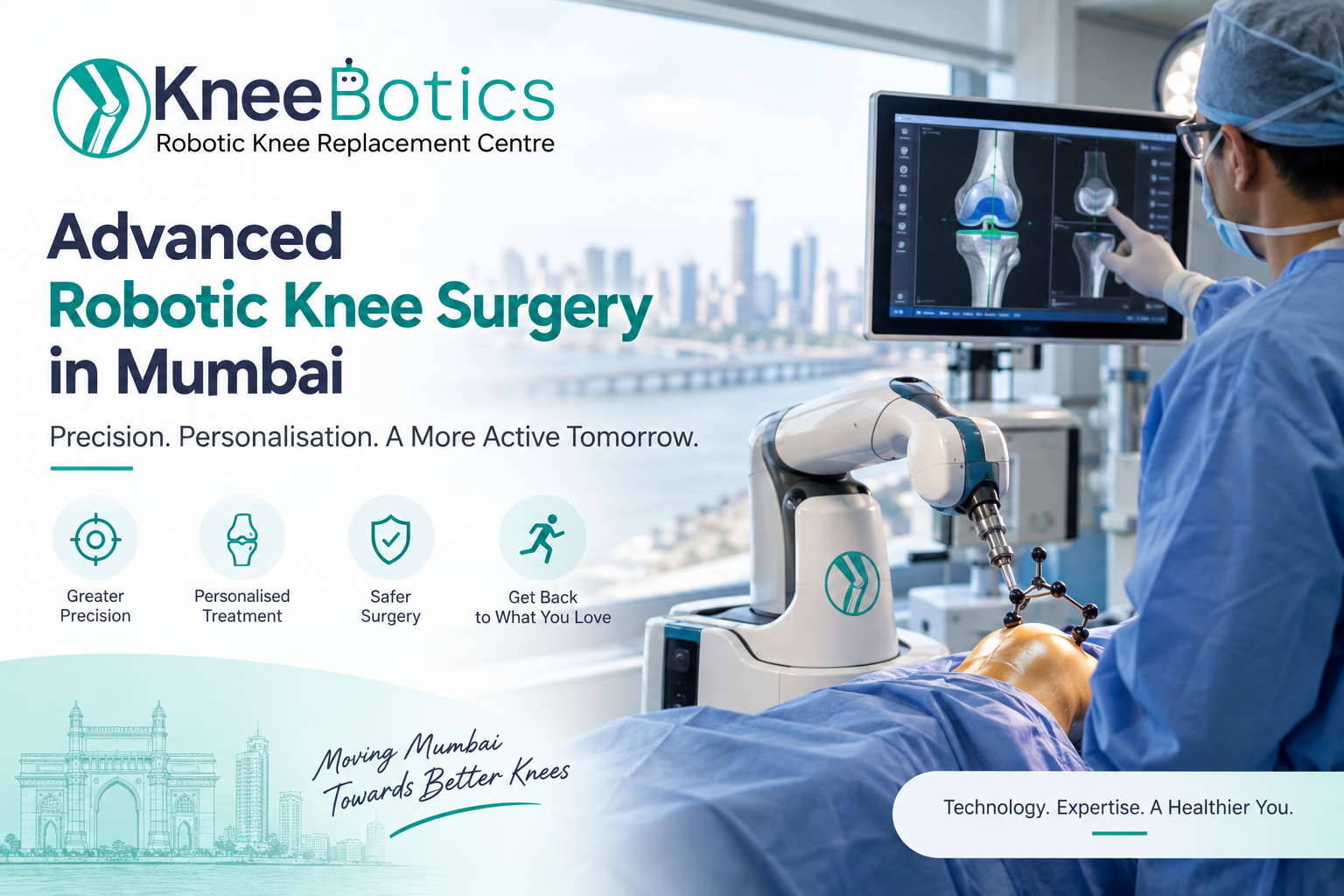


Knee pain can gradually affect almost every part of daily life—from walking and climbing stairs to exercising, travelling, and spending time with family. When arthritis or advanced joint damage no longer responds adequately to medicines, physiotherapy, injections, or other non-surgical treatments, knee replacement may be considered.
With advances in orthopaedic technology, robotic surgery in Mumbai is providing surgeons with sophisticated tools for planning and performing knee replacement procedures with greater precision and personalization.
At Kneebotics, robotic-assisted knee replacement is performed using the VELYS™ Robotic-Assisted Solution, which supports the surgeon in planning and executing the procedure according to the patient’s individual knee anatomy.
What Is Robotic-Assisted Knee Surgery?
Robotic-assisted knee surgery is not a procedure where a robot independently performs the operation. Instead, the orthopedic surgeon remains in complete control while robotic technology provides information, planning tools, and assistance during critical stages of the procedure.
The technology can help the surgeon:
- Create a personalized surgical plan
- Assess the patient’s knee anatomy
- Make precise bone preparations
- Optimize implant positioning and alignment
- Balance the knee joint
- Preserve appropriate healthy bone and soft tissue where possible
This combination of surgical expertise and computer-assisted technology allows the procedure to be tailored more closely to each patient’s anatomy.
Why Is Precision Important in Knee Replacement?
A knee replacement involves removing damaged portions of the joint and positioning an artificial implant. Implant alignment, positioning, and soft-tissue balance are important considerations because they can influence the function and stability of the reconstructed knee.
Robotic systems provide the surgeon with additional information and planning capabilities during the procedure. The goal is not simply to use advanced technology, but to help the surgeon execute a carefully planned operation with accuracy.
At Kneebotics, the VELYS system is used to support personalized surgical planning based on the patient’s anatomy.
Robotic Knee Replacement in Mumbai: What Are the Potential Benefits?
Depending on the patient’s condition and the type of procedure performed, robotic-assisted knee replacement may offer several potential advantages.
1. Personalized Surgical Planning
Every knee is different. The extent of arthritis, bone shape, alignment, and soft-tissue condition can vary considerably between patients.
Robotic technology can assist the surgeon in developing a surgical plan based on the individual’s anatomy rather than relying solely on a generalized approach.
2. Precise Implant Positioning
Correct implant placement is an important part of knee replacement surgery. Robotic assistance can help the surgeon plan and execute bone preparation and implant positioning with a high degree of precision.
3. Attention to Knee Alignment
Alignment is an important consideration in knee replacement because it can affect how the reconstructed joint functions.
Computer-assisted planning gives the surgeon additional information that can be used when assessing alignment and joint balance during surgery.
4. Potentially Faster Rehabilitation
Recovery varies from patient to patient and depends on factors such as age, general fitness, the severity of arthritis, the type of replacement performed, and adherence to rehabilitation.
Some patients undergoing robotic-assisted knee replacement may experience a quicker return to everyday activities, although robotic technology does not guarantee a particular recovery time.
What Is Robotic Partial Knee Replacement in Mumbai?
Not every patient with knee arthritis needs a total knee replacement.
When arthritis is limited primarily to one compartment of the knee and the remaining portions of the joint are relatively healthy, robotic partial knee replacement in Mumbai may be considered.
During a partial knee replacement, only the damaged portion of the knee is replaced while appropriate healthy parts of the joint are preserved. Robotic assistance can help the surgeon plan implant placement and bone preparation for this more targeted procedure.
Who May Be Considered for Partial Knee Replacement?
Suitability for partial knee replacement depends on several clinical factors. Your orthopedic surgeon may assess:
- Where the arthritis is located
- The condition of the other knee compartments
- Knee alignment
- Ligament stability
- Range of motion
- The severity of joint damage
- Your symptoms, activity level, and treatment goals
- Findings from physical examination and imaging
Partial knee replacement is not appropriate for everyone. Advanced arthritis affecting multiple compartments, certain ligament problems, significant deformity, and other conditions may make total knee replacement or another treatment more appropriate.
For this reason, a detailed orthopedic assessment is essential before deciding between partial and total knee replacement.
Robotic Partial vs Total Knee Replacement
The choice between partial and total knee replacement should be based on the patient’s individual condition rather than simply choosing the procedure that uses newer technology.
Partial knee replacement focuses on replacing the damaged compartment while preserving suitable parts of the natural knee.
Total knee replacement replaces the damaged surfaces of the knee when arthritis or joint damage is more widespread.
Robotic assistance can be used in knee replacement procedures to support planning and surgical precision, but the appropriate procedure depends on the patient’s diagnosis and anatomy.
Is Robotic Surgery Better Than Conventional Knee Replacement?
Robotic-assisted surgery and conventional knee replacement both rely on the skill and judgment of an orthopedic surgeon.
The major difference is the additional technology available during robotic-assisted procedures. Robotic platforms can provide computer-assisted planning, anatomical information, and intraoperative guidance.
However, robotic technology does not eliminate the risks associated with surgery, and it does not guarantee a specific outcome. Patient selection, surgical expertise, rehabilitation, and appropriate postoperative care remain important factors.
What Happens Before Robotic Knee Surgery?
Before recommending surgery, your orthopedic specialist will typically evaluate your symptoms, medical history, physical condition, knee movement, and imaging.
The assessment helps determine:
- Whether knee replacement is appropriate
- Whether partial or total replacement is more suitable
- Whether robotic assistance may be beneficial
- What implant and surgical approach may be appropriate
- What rehabilitation plan you may need after surgery
A personalized evaluation is particularly important because not every patient with knee pain requires replacement surgery.
Recovery After Robotic Knee Replacement
Recovery is different for every individual.
Your rehabilitation may include:
- Physiotherapy and prescribed exercises
- Gradual weight-bearing and walking
- Exercises to restore knee movement
- Strengthening of the surrounding muscles
- Follow-up consultations
- Gradual return to everyday activities
Some patients may begin supported walking soon after surgery, but the exact recovery timeline should be determined by the treating surgeon and rehabilitation team.
Following postoperative instructions and participating consistently in rehabilitation can be just as important as the surgical procedure itself.
Choosing a Robotic Knee Surgeon in Mumbai
When considering robotic-assisted knee replacement, it is useful to look beyond the technology itself.
Patients should consider:
- The surgeon’s orthopedic and joint-replacement experience
- Experience with robotic-assisted procedures
- The robotic platform being used
- The surgeon’s approach to patient selection
- Hospital and surgical facilities
- Preoperative planning
- Postoperative rehabilitation and follow-up
- Whether the recommended procedure is appropriate for the individual’s condition
At Kneebotics, Dr. Kunal Patel is presented as a consultant orthopedic surgeon and robotic knee replacement specialist. The practice uses the VELYS Robotic-Assisted Solution for knee replacement procedures.
Frequently Asked Questions
Is robotic knee surgery performed by a robot?
No. Robotic-assisted knee surgery remains surgeon-controlled. The robotic system assists with planning, measurements, and precise execution, while the orthopedic surgeon controls the procedure.
Is robotic knee replacement suitable for everyone?
No. The appropriate treatment depends on the severity and location of joint damage, overall knee condition, medical history, and other clinical factors. An orthopedic assessment is necessary to determine whether robotic-assisted replacement is appropriate.
What is the difference between robotic partial and total knee replacement?
A partial replacement addresses the damaged portion of the knee and preserves suitable healthy areas. A total replacement is generally considered when damage affects multiple parts of the knee.
Does robotic surgery mean a faster recovery?
Robotic assistance may support precise surgical planning and execution, and some patients may experience an efficient recovery. However, recovery varies significantly between individuals and cannot be guaranteed solely because robotic technology was used.
Do I need robotic knee replacement if I have arthritis?
Not necessarily. Knee arthritis can often be managed with non-surgical treatments depending on its severity. If surgery becomes necessary, your orthopedic surgeon can determine whether partial or total replacement—and whether robotic assistance—is appropriate.
Take the Next Step for Your Knee Health
Persistent knee pain should not automatically mean that you need a knee replacement. The right treatment begins with an accurate diagnosis and an individualized assessment.
For patients who do require joint replacement, robotic surgery in Mumbai offers an advanced approach that combines orthopedic expertise with computer-assisted technology. For carefully selected patients with arthritis limited to one compartment, robotic partial knee replacement in Mumbai may provide an alternative to replacing the entire knee.
At Kneebotics, the focus is on personalized planning, robotic-assisted technology, surgical expertise, and structured postoperative care.
If ongoing knee pain is affecting your mobility or quality of life, consult an experienced orthopedic specialist to understand your treatment options and determine which approach is appropriate for your knee.

- Robotic Surgery in Mumbai: A Modern Approach to Knee Replacement - September 16, 2026
- MS Angle Manufacturer in Mandi Gobindgarh, Punjab: What to Look for Before Buying - September 15, 2026
- Why Good Indian Restaurants Adelaide City Are Loved by Locals and Visitors - September 7, 2026
