
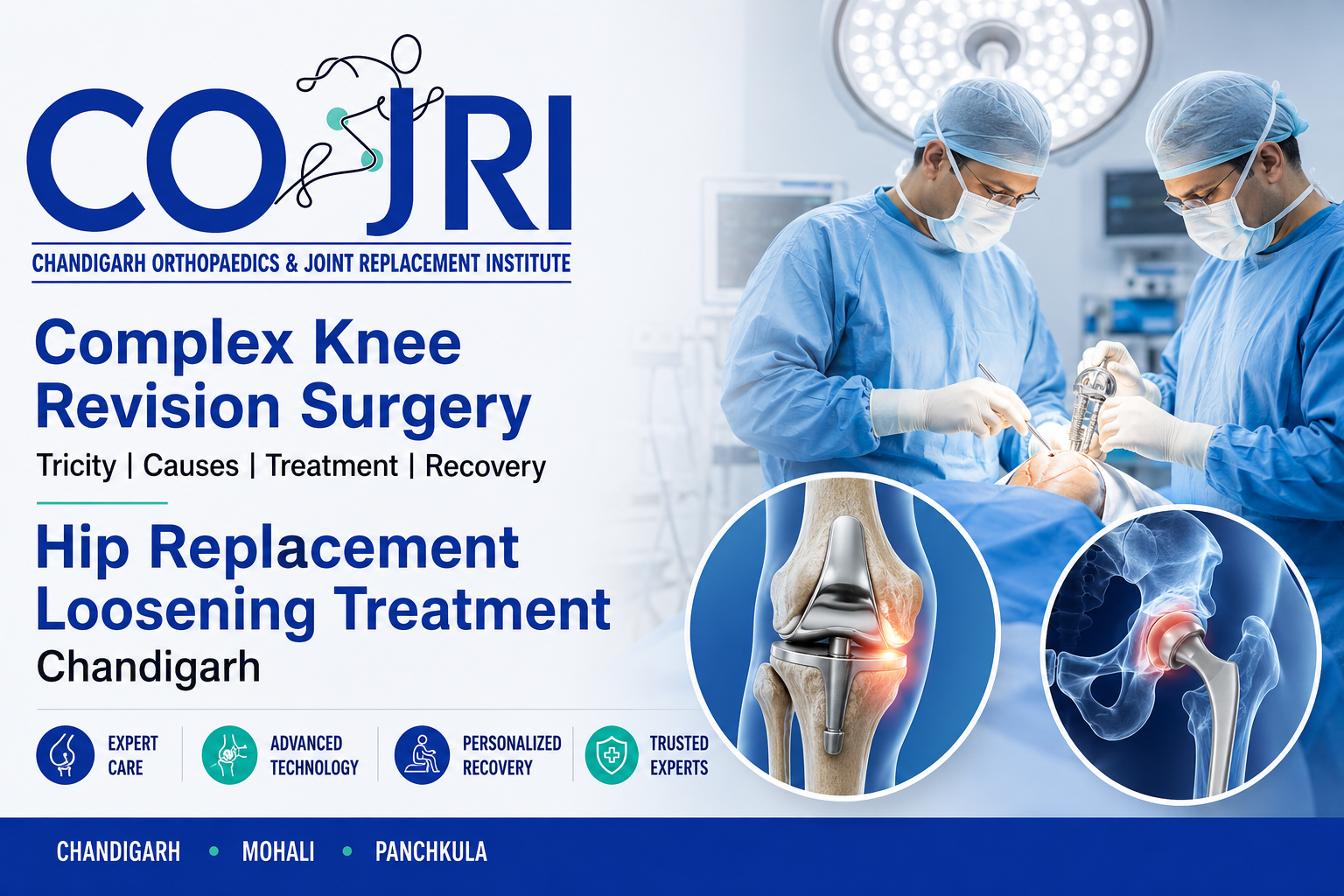


A knee replacement is designed to reduce pain, restore mobility, and help patients return to everyday activities. However, in some cases, an artificial knee can develop problems years after the original operation. Persistent pain, instability, infection, implant loosening, wear, stiffness, or a fracture around the implant may indicate that the replacement is no longer functioning as intended.
For patients looking for Complex knee revision surgery Tricity, understanding why a knee replacement fails and how revision treatment is planned can make the next step less uncertain.
At Chandigarh Orthopaedics & Joint Replacement Institute (COJRI), revision joint replacement is a specialized area of care, including complex reconstruction, management of bone loss, specialized implants, and infection-control protocols for difficult cases.
What Is Complex Knee Revision Surgery?
Knee revision surgery is performed when a previous knee replacement has failed or developed a significant complication. Unlike primary knee replacement, revision surgery involves working around an existing implant and may require removal of the old components, treatment of damaged bone or soft tissue, and placement of specialized revision implants.
A straightforward revision and a complex revision are not necessarily the same. Some patients may have substantial bone loss, scar tissue, infection, instability, or an implant that has been difficult to remove. These factors can make reconstruction considerably more challenging.
A detailed assessment is therefore essential before deciding whether revision surgery is appropriate.
Why Can a Knee Replacement Fail?
Several factors can contribute to failure of a knee replacement.
1. Implant Loosening
Over time, the connection between an implant and the surrounding bone can weaken. A loose implant may cause pain, instability, or difficulty walking.
2. Infection
An infection around a knee replacement can occur soon after surgery or, in some cases, much later. Infection requires careful investigation because the treatment approach can differ substantially from that used for mechanical failure.
3. Implant Wear
Artificial joint components can gradually wear with use. Significant wear can affect knee function and may contribute to bone loss around the implant.
4. Instability
If the artificial knee does not remain sufficiently stable during movement, patients may experience a sensation of the knee giving way or difficulty performing everyday activities.
5. Bone Loss
Bone surrounding a failed implant can deteriorate. When substantial bone deficiency is present, reconstruction may require specialized implants or bone-restoration techniques.
6. Fracture Around the Implant
A fall or other injury can cause a fracture around an existing knee replacement. Treatment depends on the location and severity of the fracture and the stability of the implant.
COJRI lists loosening, infection, mechanical failure, recurrent problems, and fractures around existing implants among the situations in which revision joint replacement may be required.
Signs You May Need an Evaluation for Knee Revision
Not every painful knee replacement requires another operation. However, new or worsening symptoms should not be ignored.
Speak with an orthopaedic specialist if you develop:
- Persistent or increasing knee pain
- A feeling that the knee is unstable
- Difficulty walking that was not present previously
- Recurrent swelling
- Increasing stiffness
- Clicking or unusual movement associated with pain
- A feeling that the knee is giving way
- New pain after a fall or injury
- Fever, wound problems, or other symptoms that could indicate infection
Early assessment can help identify the cause of the problem and determine whether treatment can be managed without revision surgery or whether reconstruction is necessary.
How Is a Failed Knee Replacement Diagnosed?
The first step is to identify why the knee replacement is failing.
Your orthopaedic surgeon may review your previous surgical records, examine your knee, assess your walking pattern and range of motion, and review previous and current imaging.
Depending on the suspected cause, investigations may include:
- X-rays
- Advanced imaging when required
- Blood tests
- Tests to evaluate possible infection
- Joint aspiration in selected cases
- Assessment of bone quality and bone loss
The diagnosis is particularly important in revision surgery because simply replacing an implant without addressing the underlying reason for failure may not solve the problem.
What Happens During Complex Knee Revision Surgery?
The exact procedure varies from patient to patient.
In general, the surgeon may need to:
- Carefully expose the existing knee replacement.
- Remove the failed or infected components.
- Assess the surrounding bone and soft tissues.
- Address bone defects or bone loss.
- Treat infection if present.
- Reconstruct the knee using appropriate revision components.
- Check stability and alignment.
- Develop an individualized postoperative rehabilitation plan.
Complex revision cases may require specialized implants and reconstruction techniques. COJRI’s revision joint replacement service highlights complex reconstruction, custom implant options for severe defects, bone-loss management, and infection-control protocols.
Is Revision Knee Replacement More Difficult Than the First Surgery?
Yes, revision knee replacement can be more technically demanding than primary knee replacement.
The surgeon may be dealing with scar tissue, reduced bone stock, an existing implant, altered anatomy, previous infection, or weakened soft tissues. The treatment plan therefore needs to be based on the specific reason for failure and the condition of the knee at the time of revision.
This is why patients considering Complex knee revision surgery Tricity should look for a centre with experience in revision and complex joint reconstruction rather than treating every failed replacement like a routine primary knee replacement.
What About Recovery After Revision Surgery?
Recovery depends on the complexity of the procedure, the patient’s general health, bone quality, the reason for revision, and the reconstruction required.
COJRI describes a staged recovery pathway for revision joint replacement that can include protected weight-bearing and physiotherapy during the first few weeks, gradual return to daily activities over the following months, and continued strength and mobility work thereafter.
Your rehabilitation plan may include:
- Pain and swelling management
- Assisted walking
- Range-of-motion exercises
- Physiotherapy
- Progressive strengthening
- Gradual increase in daily activities
- Regular follow-up examinations
The timeline is individual, so patients should follow their surgeon’s specific weight-bearing and rehabilitation instructions.
Hip Replacement Loosening: When Should You Seek Treatment?
Problems with joint replacements are not limited to the knee. Hip implants can also loosen over time, potentially causing pain and reduced mobility.
Patients searching for Hip replacement loosening treatment Chandigarh may notice symptoms such as renewed groin or thigh pain, difficulty walking, instability, limping, or a gradual decline in function after previously successful hip replacement surgery.
Hip implant loosening can have different causes, including wear-related bone loss, infection, trauma, poor bone quality, or mechanical problems. Diagnosis may involve clinical examination, X-rays, CT imaging, blood tests, and, where appropriate, joint aspiration to investigate infection.
Can a Loose Hip Replacement Be Treated Without Surgery?
Treatment depends on the severity and cause of loosening.
In selected patients with limited symptoms, a specialist may initially recommend observation, activity modification, pain management, physiotherapy, or mobility support. These measures do not, however, repair a significantly loose implant.
When there is substantial loosening, bone loss, infection, or mechanical failure, revision hip replacement may be considered. COJRI’s revision hip replacement service describes removal and replacement of an older implant when problems such as loosening, infection, wear, dislocation, fractures, or mechanical failure occur.
Why Choose a Specialist Revision Joint Replacement Centre?
Revision surgery requires a different level of planning from a routine primary replacement.
When evaluating a centre for revision treatment, patients should consider:
- Experience with complex revision cases
- Appropriate diagnostic evaluation
- Ability to manage bone loss
- Availability of specialized revision implants
- Infection-management protocols
- Individualized surgical planning
- Structured postoperative rehabilitation
- Convenient follow-up care
COJRI provides primary and revision hip and knee replacement services, complex reconstruction, robotic-assisted joint replacement, and recovery and physiotherapy support.
When Should You See an Orthopaedic Specialist?
If your knee or hip replacement was previously working well but you have developed new pain, instability, swelling, reduced mobility, or difficulty walking, arrange an orthopaedic assessment rather than assuming the symptoms are simply part of ageing.
A timely evaluation can help determine whether the issue is related to the implant, surrounding bone, infection, soft tissues, or another cause.
For patients in Chandigarh, Mohali, and Panchkula, COJRI offers access to joint replacement and revision services across the Tricity region.
Frequently Asked Questions
1. What is complex knee revision surgery?
Complex knee revision surgery is a procedure performed to address a failed or problematic previous knee replacement when the case involves challenges such as significant bone loss, infection, instability, damaged tissues, fractures, or difficult implant removal.
2. What are the common reasons for knee revision?
Common reasons include implant loosening, infection, wear, instability, mechanical failure, persistent dysfunction, bone loss, and fractures around the knee replacement.
3. Is revision knee replacement more complicated than primary replacement?
It can be. Previous surgery may leave scar tissue, bone loss, and altered anatomy, making revision reconstruction more technically demanding than the original replacement.
4. How long does recovery take after revision knee surgery?
Recovery varies according to the procedure and the patient’s health. Some patients require protected weight-bearing and a longer rehabilitation programme, particularly when substantial reconstruction has been performed.
5. What are the signs of a loose hip replacement?
Possible symptoms include renewed hip or groin pain, thigh or buttock discomfort, limping, difficulty walking, reduced movement, or a feeling of instability.
6. Can hip implant loosening be treated without revision surgery?
Mild or uncertain cases may sometimes be monitored or managed conservatively. Significant mechanical loosening generally requires specialist evaluation and may require revision surgery.
7. Is revision hip replacement the same as primary hip replacement?
No. Revision surgery involves dealing with an existing implant and may also involve scar tissue, bone loss, infection, or other complications. COJRI notes that recovery can be more involved than after primary hip replacement.
8. When should I see a specialist after a joint replacement?
New or worsening pain, instability, swelling, difficulty walking, or other changes in a previously well-functioning joint replacement should be evaluated by an orthopaedic specialist.
Final Takeaway
A failed knee or hip replacement does not necessarily mean that you have to live with persistent pain or reduced mobility. The key is to identify the reason for failure and develop a treatment plan based on the condition of the implant, bone, soft tissues, and overall health.
For patients seeking Complex knee revision surgery Tricity, specialist assessment and careful reconstruction planning are particularly important. Similarly, anyone researching Hip replacement loosening treatment Chandigarh should seek evaluation when new symptoms develop after hip replacement.
COJRI focuses on primary and revision joint replacement, complex reconstruction, robotic-assisted procedures, and rehabilitation support for patients across Chandigarh, Mohali, and Panchkula.
NAP — COJRI
Name: Chandigarh Orthopaedics & Joint Replacement Institute (COJRI)
Primary Centre: Max Hospital, Phase 6, SAS Nagar, Mohali, Punjab
Chandigarh Clinic: Singla Clinics, House No. 3, Sector 19A, Chandigarh, 160019
Panchkula Clinic: House No. 222, Sector 4, Panchkula, Haryana 134112
Phone: +91 98159 33514 +91 84272 70319
Email: info@cojri.com

- Complex Knee Revision Surgery in Tricity: Causes, Treatment, Recovery & What Patients Should Know - August 26, 2026
- Wastewater Testing Laboratory Punjab: Reliable Environmental Testing & Solid Waste Management Solutions - August 26, 2026
- Lady Doctor in Mohali: Complete Women’s Healthcare & Vaginal Infection Treatment in Chandigarh - August 26, 2026
